Meowdoku

 0/4
0/4Current statusClick an empty cell to place X. Double-click or right-click an empty cell to place a cat. Click a marked cell again to clear it.
Play Meowdoku on Google Play
Install the Android version to keep Meowdoku ready on your phone.
How to Play Meowdoku
Understand the board
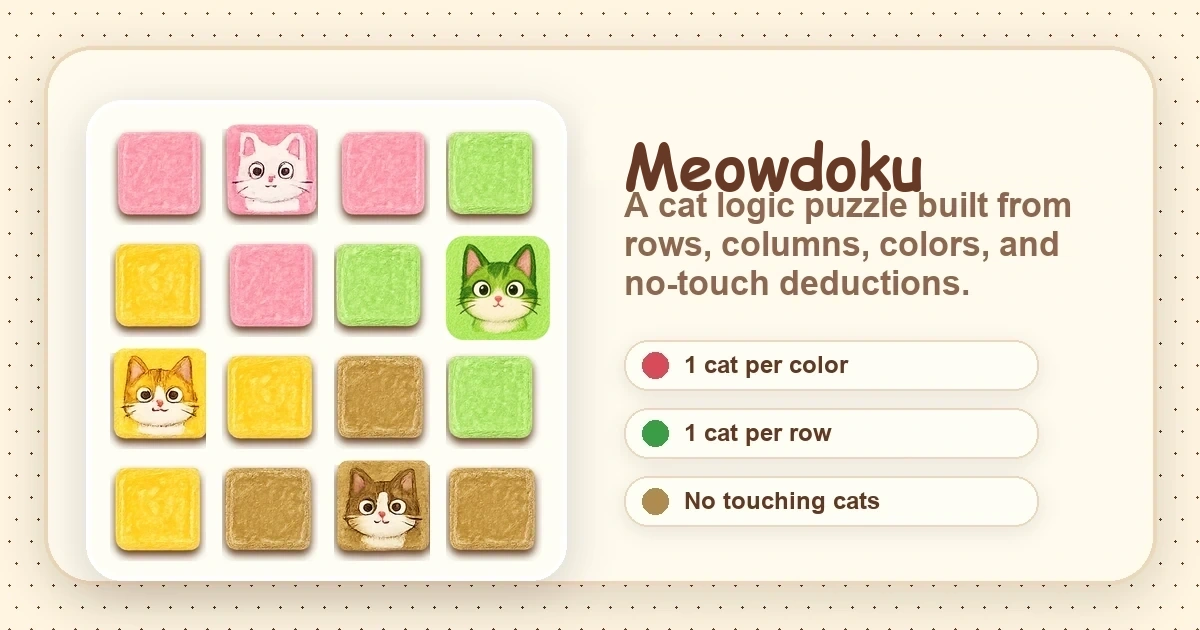
Meowdoku is a browser logic puzzle about placing cats with care, not speed. Each board in meowdoku is divided into colored regions, and your goal is to place exactly one cat in every row, every column, and every color region. The twist that makes meowdoku satisfying is the no-touch rule: two cats may not sit next to each other horizontally, vertically, or diagonally. Start by scanning the colors, then look at rows and columns that have only a few possible cells. In meowdoku, a good first move is often an X mark, because removing one impossible cell can make a whole region easier to read.
Mark impossible cells first
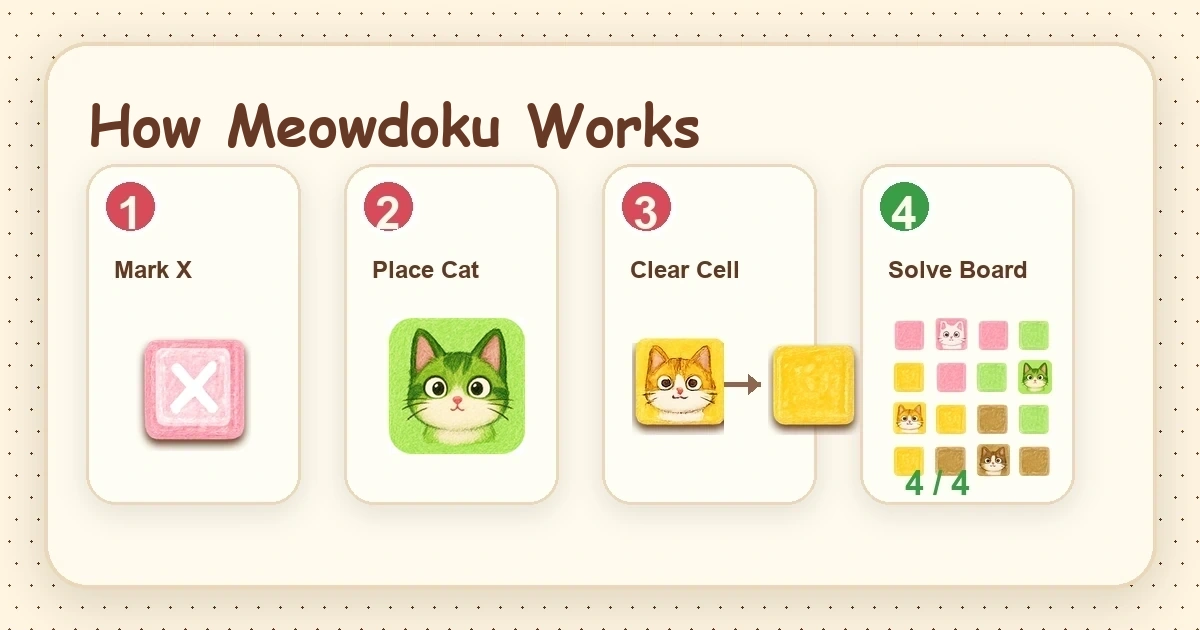
To play meowdoku, click an empty cell once to place an X. Use an X when you are confident a cat cannot go there. Double-click, or right-click on desktop, to place a cat. If a cell already has a cat or an X, click it again to clear it. This simple input keeps meowdoku comfortable on phones and tablets while still feeling precise on desktop. When you place a cat in a color region, any previous cat in the same color is removed automatically, because meowdoku allows only one cat per color. That rule helps you test ideas quickly without leaving duplicate pieces behind.
Use rows, columns, and colors together
The best meowdoku strategy is to move from certainty to possibility. First, find any color region that appears mostly inside one row or one column. If that region needs a cat, it can block many nearby cells. Next, apply the no-touch rule around every confirmed cat. In meowdoku, adjacent cells are unsafe even when they are diagonal, so each cat creates a small exclusion zone. Mark those unsafe cells with X when the conclusion is clear. Then return to the rows and columns. A row with one remaining safe cell must receive a cat, and the same logic applies to columns and colors.
Advance through harder levels
Meowdoku becomes deeper as boards grow from easy five-cat puzzles into medium and hard layouts. Larger meowdoku levels may have six, eight, ten, or twelve cats, but the core rhythm stays the same: one cat in every row, one cat in every column, one cat in every color, and no touching. Avoid guessing too early. If two cells seem possible, look at what each choice would force in the neighboring rows and colors. Strong meowdoku solving often comes from asking which option leaves every remaining region with at least one legal cell.
Check and undo without penalty
Use the Check button in meowdoku as feedback, not as a penalty. Meowdoku highlights suspicious cells or tells you that more cats are still missing. It does not take hearts away, so you can learn the pattern of a level and revise your board. The Undo button is useful when you want to compare two branches of thought. In meowdoku, small reversals are normal: place a cat, watch which X marks become obvious, undo if the placement creates a contradiction, then try the alternative.
Try the daily challenge
Daily Challenge selects a hard meowdoku level for the day, which is a good way to practice advanced deduction without choosing from the full list. If you are new to meowdoku, begin with the first levels and pay attention to how colors form shapes. Color regions are not decoration; they are one of the three main constraints. A color that snakes through many rows can be harder than a compact block, because a single cat placement may affect several parts of the board. In meowdoku, treat every color as a mini puzzle inside the larger grid.
Finish with a clean deduction loop
A completed meowdoku board should feel balanced: every row has one cat, every column has one cat, every color has one cat, and no cat touches another. If your board is almost finished but wrong, do not erase everything. In meowdoku, the quickest repair is usually to find the first row, column, or color with a duplicate or a missing cat, then trace the effect outward. With practice, meowdoku turns into a clean deduction loop: mark impossible cells, place forced cats, check adjacency, and repeat until the whole board resolves.